
Why do creators with attention still struggle to earn?
Nano Team
Nano Impact Writer

Everyone can go viral. Not everyone can build a living. Here is what the creator economy is missing and what comes next.
Something does not add up.
Nigeria has one of the most active creator ecosystems in the world. Every day, timelines are filled with skits, commentary threads, TikTok trends, Instagram storytelling. Culture is being shaped in real time.
And yet, if you speak to enough creators privately, a different story starts to emerge. A quieter one.
"I get views... but I'm not making money like that."
That gap, between being seen and actually earning, is where the real story of the creator economy lives.
For years, the internet has trained creators to optimize for one thing: attention. Go viral. Trend. Stay consistent. And to be fair, it works, at least on the surface. You can wake up with 50,000 views on a video. You can trend on X. You can build an audience that genuinely engages with your work.
But then what? Because if we are being honest, a lot of creators are quietly asking the same question: if I already have attention, why does it not translate to opportunity?
01 THE ATTENTION PARADOX
When the Numbers Look Fine but the Reality Does Not
In economics, there is a concept that explains why things can feel expensive even when the data suggests they should not.
In a recent PiggyVest publication, Treasure Okure breaks this down while writing about inflation. She explains that even when inflation rates decline, the cost of living does not immediately feel easier. Not because prices have not adjusted at all, but because the underlying economic system has not shifted in a way that people can meaningfully experience.
On paper, things are improving. In reality, people still feel the pressure.
That distinction matters. Because something similar is happening in the creator economy.
On the surface, everything looks like it is working:
● more creators
● more content
● more reach
● more visibility
But when you look at lived experience, a different picture shows up. Income is inconsistent. Opportunities are uneven. Growth is difficult to sustain.
In economics, this is a disconnect between indicators and outcomes. Attention is increasing, but its value is not compounding at the same rate. Visibility alone is no longer enough. Not because it does not matter, but because the system around it has not evolved to convert it into something more stable.
CHART 01 · The Attention vs Income Gap
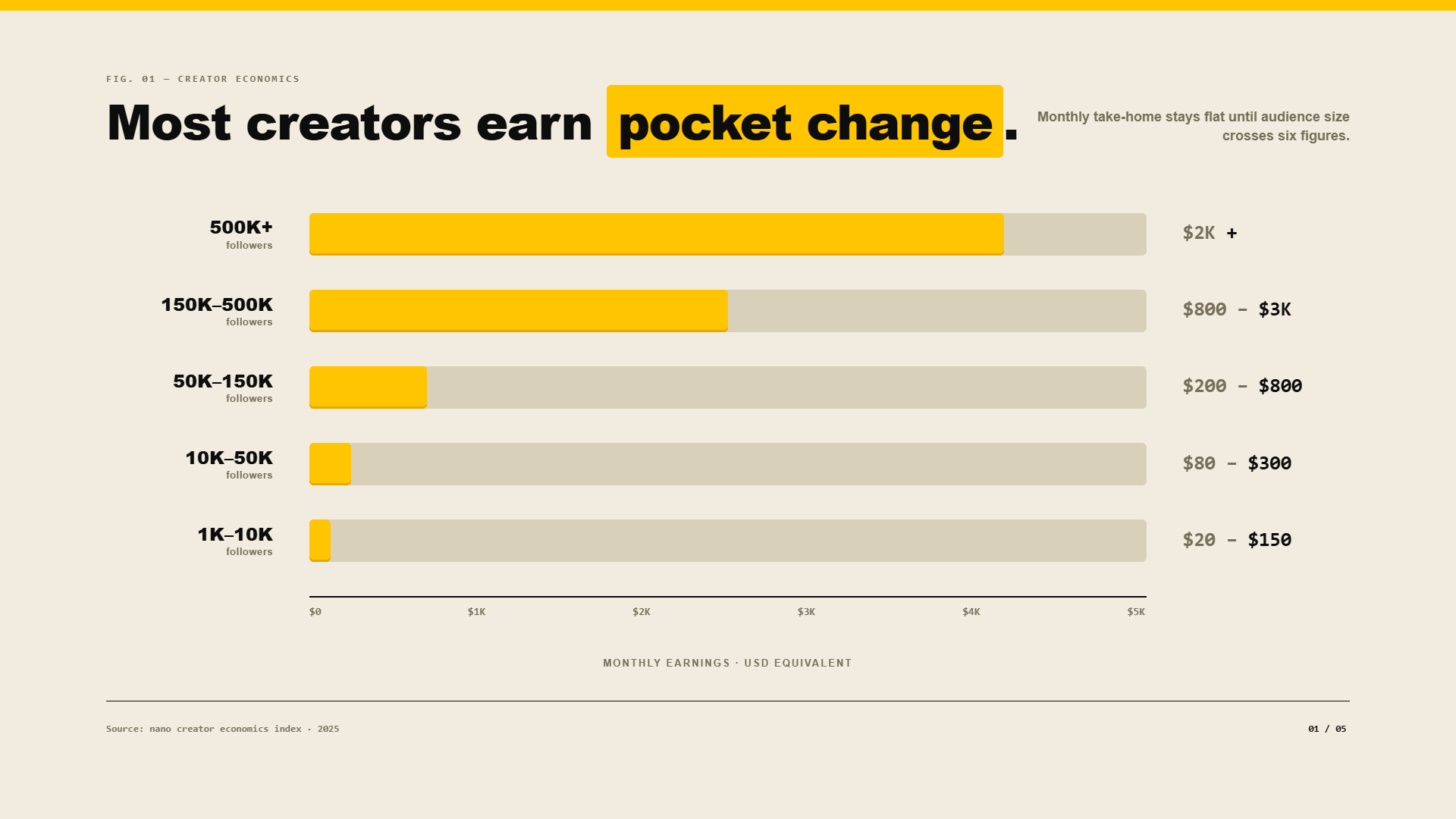
Creators have audiences. Income does not match.
↳ Estimates are USD equivalent drawn from aggregated creator surveys across West Africa. A creator with 50K followers may earn under $300 per month, while a brand sees that same audience as a significant marketing asset.
02 WHEN VIRALITY BECOMES THE BASELINE
Reach Is No Longer the Advantage
There was a time when going viral meant something rare. Now it does not. Platforms like TikTok and Instagram have made distribution easier than ever. Content travels faster. Discovery is more fluid. But when everyone has access to attention, attention stops being the advantage. It becomes the starting point.
And this is where the system begins to show its limits. Most platforms were designed to help creators get seen, not to help them get paid, secure structured opportunities, or build long-term value.
What This Looks Like in Real Life
Take Mr Macaroni. A large audience, strong cultural relevance, consistent visibility. But the real value at that level does not come from views alone. It comes from structured partnerships, repeatable brand relationships, and a system that converts attention into revenue.
Now scale that down to the average creator. Someone with 5,000 followers. Or 10,000. Or even 20,000. They have influence. They have community. But access remains limited.
Consider Korty EO. Her work is deliberate, culturally grounded, and distinct. Her growth has not been driven by chasing trends, but by building a clear creative identity over time. And even then, monetisation depends on structures outside the platform itself.
Then there is KieKie. She operates at the intersection of entertainment, fashion, and brand storytelling. What stands out is not just output, but how that output translates into sustained brand collaborations.
That is not accidental. That is structure.
03 WHERE THE SYSTEM BREAKS
A Collection of Disconnected Interactions, Not a Market
If you zoom out, the gap becomes obvious. Creators exist. Brands exist. Marketing budgets exist. But the system that connects all three remains fragmented and, more importantly, inefficient.
What exists today is not a true market system. It is a collection of disconnected interactions. On the brand side, discovery is still largely driven by familiarity, visibility metrics, or closed networks. High-potential creators are often overlooked, while access stays concentrated among a few.
On the creator side, monetisation is unpredictable. Opportunities are:
● inconsistent
● difficult to access
● rarely repeatable
This introduces income volatility. It makes it difficult for creators to treat their work as a stable economic activity.
Most collaborations still happen in isolation: one creator, one post, one outcome. No coordination. No aggregation of reach. No system for compounding results. Brands cannot fully optimise spend. Creators cannot maximise earning potential. And outcomes stay below what the ecosystem is capable of producing.
The system is active. But it is not yet structured.
CHART 02 · Discovery Mechanics
Campaign reach extends far beyond existing followers
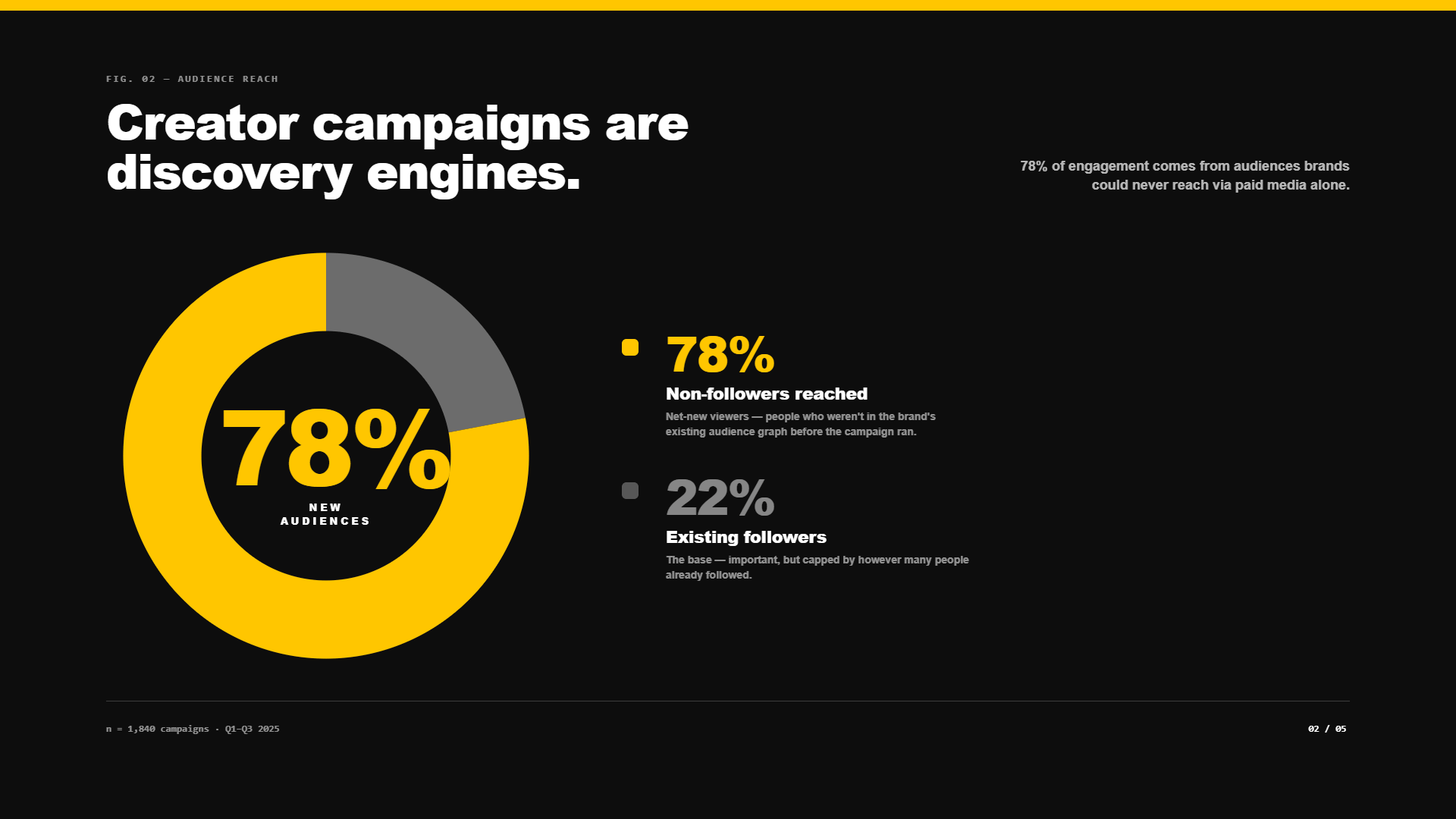
↳ Creator campaigns are not just engagement tools. They are discovery engines, reaching audiences that brands could never find through paid media alone.
04 A DIFFERENT MODEL IS STARTING TO EMERGE
From Attention Systems to Opportunity Systems
Quietly, a shift is happening. Not away from creators, but around them. From platforms that generate attention to systems that structure opportunity.
This is where NanoSocials starts to matter. Not because it is the only answer, but because it is solving a different problem. Not how to generate visibility, but how to make visibility usable.
From Random Virality to Engineered Outcomes
Traditionally, campaigns rely on chance. A brand works with one creator. The creator posts. Everyone waits. Sometimes it works. Sometimes it does not. NanoSocials removes that randomness.
During campaigns like Moment by Mainstack, a more structured approach was tested. Instead of relying on a single voice, multiple creators were onboarded, aligned to a shared objective, and deployed across their individual audiences at the same time. What that creates is layered distribution: different creators, different communities, one coordinated message.
And the data starts to show something important. A significant portion of engagement in these campaigns comes from people who were not previously following any of the creators. Discovery is no longer limited to existing audiences.
CHART 03 · Model Comparison
Traditional vs NanoSocials: a scoring breakdown
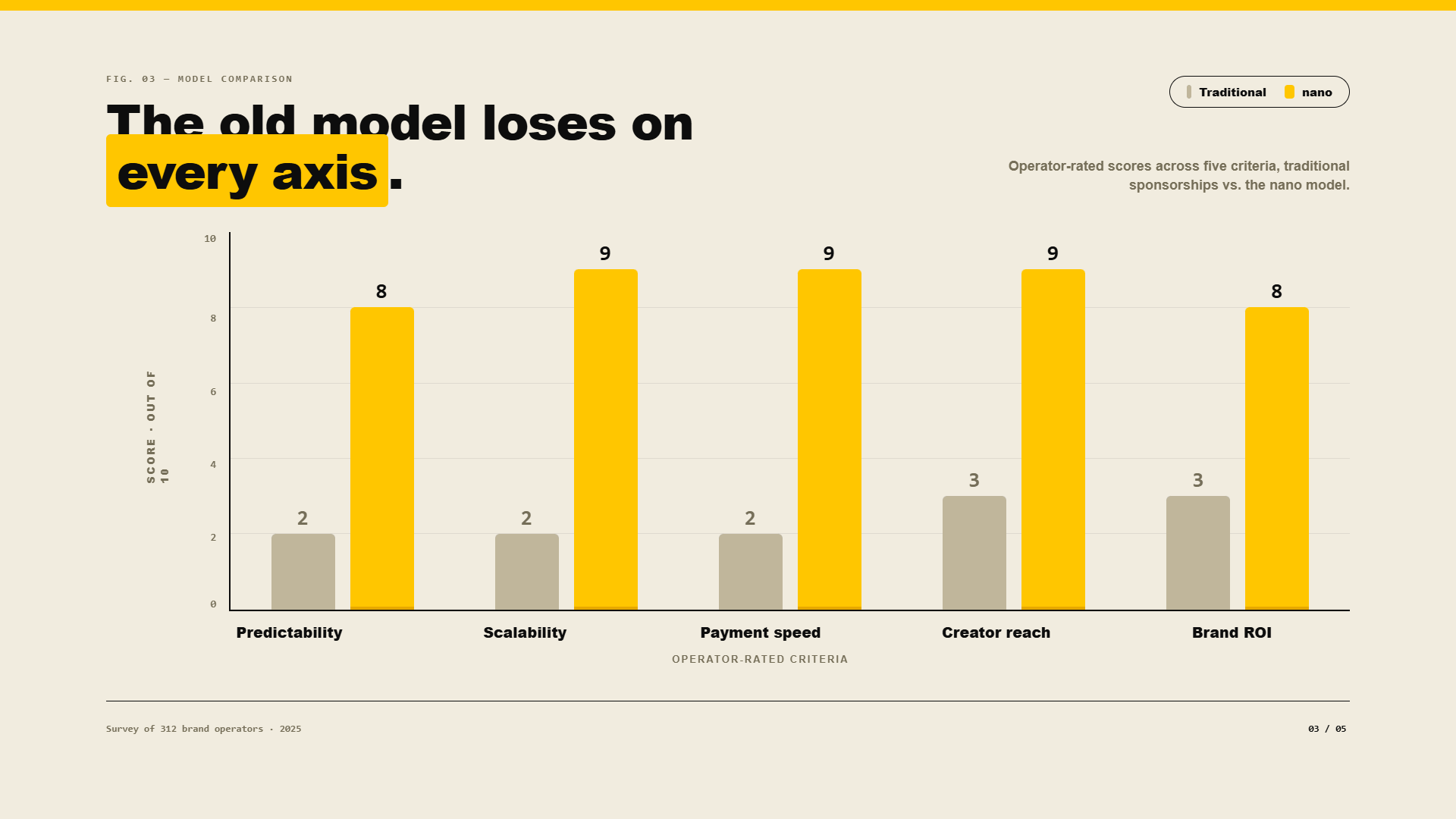
↳ Scores reflect relative performance across five dimensions critical to campaign success. The gap is widest where it matters most: payment reliability and outcome predictability.
05 WHY COORDINATION CHANGES EVERYTHING
Virality as a System, Not a Stroke of Luck
This is where the idea of engineered virality becomes useful. Not virality as luck, but virality as coordination. Matching the right creators to the right message. Deploying them intentionally. Distributing through relevant communities. Measuring outcomes.
Instead of posting and hoping, it becomes a system. And one of the most important parts of that system is what happens at the end.
Creators deliver. And they get paid. Clearly. On time. Without friction. It sounds basic, but within this ecosystem, it changes everything.
CHART 04 · System Flow
The missing middle and how NanoSocials fixes it
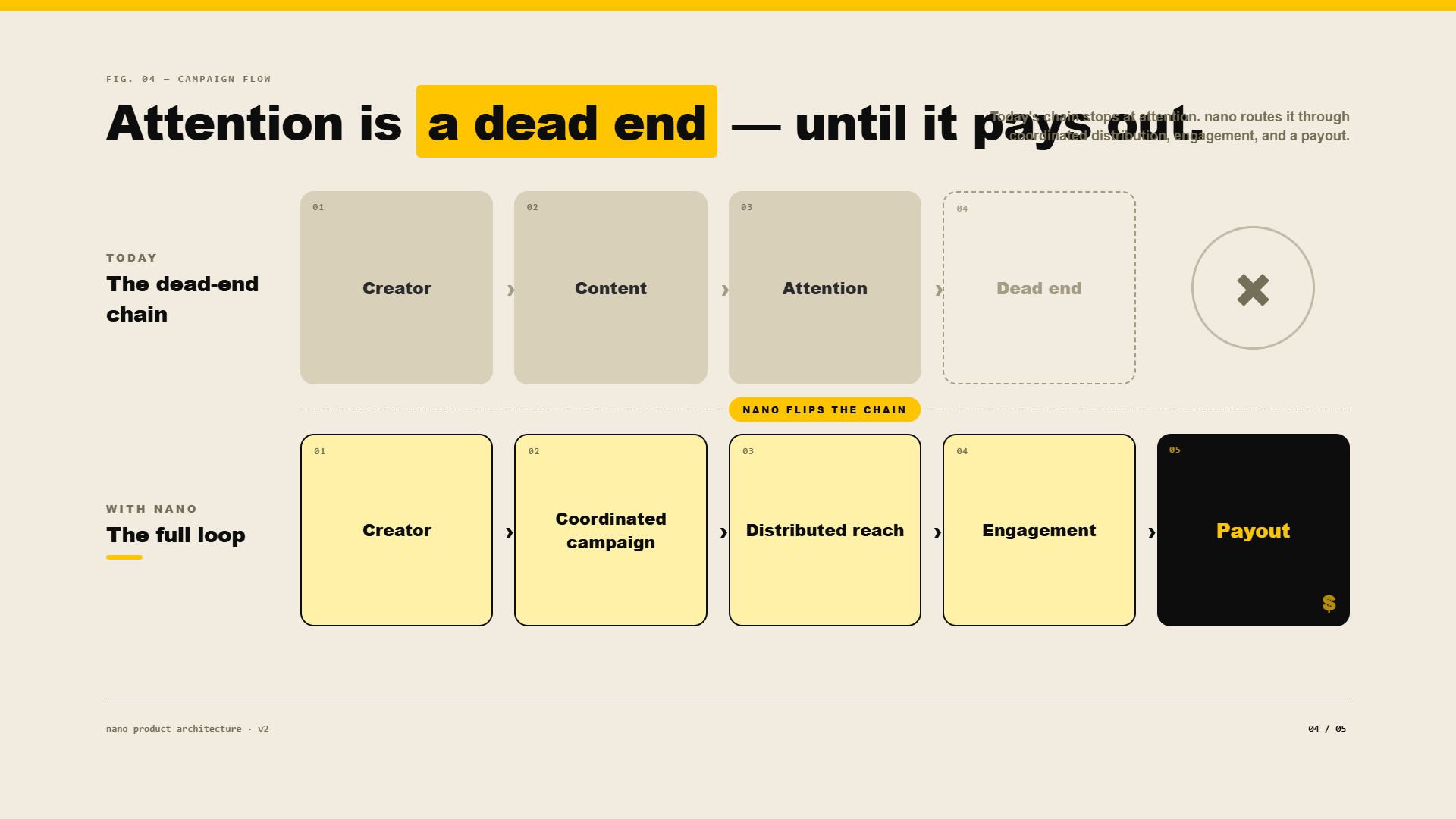
↳ Attention exists in abundance. What has been missing is the coordination layer between attention and income: the infrastructure that converts visibility into predictable, repeatable value.
06 WHY THIS MATTERS BEYOND CREATORS
A Signal for the Economy, Brands, and Policymakers
For brands, this unlocks something more reliable than reach. It unlocks trust. Audiences do not just engage with content anymore. They engage with people.
For the economy, it signals a shift. More young people are earning, creating, and participating outside traditional employment structures, building careers and income streams that do not show up in conventional job data but are very real.
For policymakers, it introduces new questions around digital labour, income systems, and economic inclusion. Questions that matter especially in markets where youth unemployment sits alongside one of the most prolific creator cultures in the world.
CHART 05 · Stakeholder Impact
What changes when the creator economy gets structured
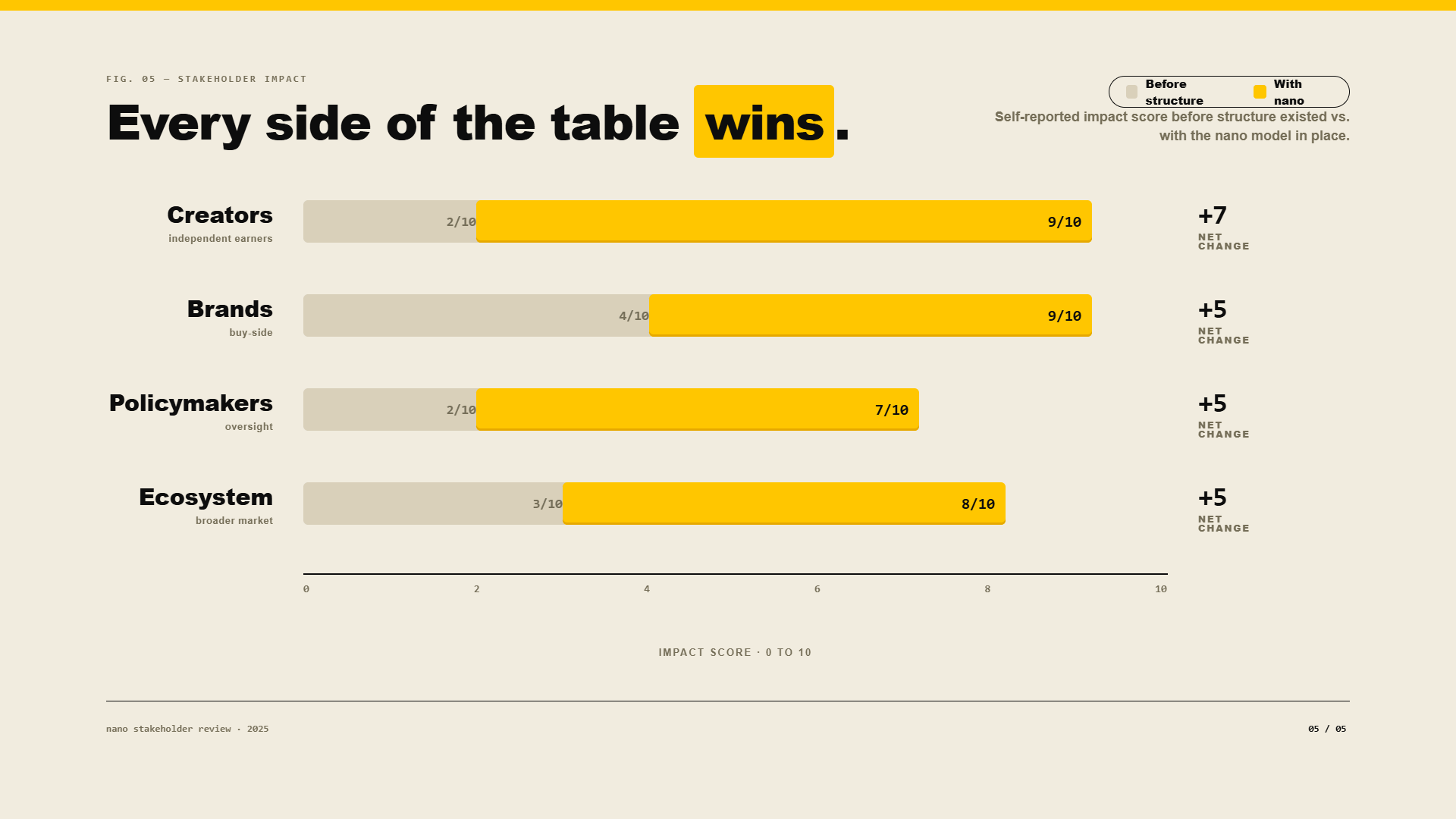
↳ The shift is not just a product feature. It is a structural change to how digital economic participation works, for creators, brands, and the broader ecosystem.
07 THE SHIFT HAPPENING QUIETLY
From an Attention System to an Opportunity System
We are moving from an attention system to an opportunity system. Visibility is being coordinated. Collaboration is being structured. Value is being distributed more intentionally.
The platforms that brought us here, TikTok, Instagram, X, solved distribution. They made it possible for anyone to be seen. That was a real unlock.
But being seen is not the same as being supported. The next layer of infrastructure, the one that converts visibility into stable, repeatable income, is only now being built.
Final Thought
The internet has already solved for attention. That part is done.
What it has not solved, especially in markets like ours, is how to make that attention consistently valuable.
Creators are not just content machines. They are storytellers. They are distributors. They are economic participants.
The future of this space will not belong to those who simply go viral. It will belong to those who can turn visibility into opportunity. Consistently. Predictably. At scale.
And the systems that make that possible are being built right now.
